
The abdications of Bayonne had left the unoccupied Spain with a lack of authority. To fill that authority void and organize the spontaneous uprisings against the French, the Juntas Provinciales were organized, and they assumed sovereignty.

In September 1808, the Junta Central Suprema assumed all the powers, in absence of the legitimate king (Fernando VII). They established themselves as the maximum government organism. The Junta Central scheduled a meeting of extraordinary Cortes in Cádiz. Finally, in January 1810, the Junta ceded its power to a Regency, but they didn’t stop the Convene of (Convocatoria) Cortes.

The meeting of Cortes in a war situation, benefited the burghers, coming from the coast and commercial cities. The sessions began in September 1810 and there were soon two groups of deputies:
- Liberals: supporting revolutionary reforms, inspired in the French Revolution principles and ideas.
- Absolutists or “serviles”: supporters of maintaining the Ancien Régime (absolute monarchy, unequal and stratified society – estates of the realm, mercantilist and agrarian economy).
The liberal majority, taking profit of the king’s absence, began a liberal revolution in Spain, with two objectives:
-
- To make reforms to end with the Ancien Régime structures.
- To approve a Constitution.
- Political reforms of the Cortes de Cádiz:
- Freedom of press (1810).
- Abolition of the feudal system: suppression of the señoríos jurisdiccionales (manor houses). Nevertheless, the nobility maintained the property of almost all their lands.
- Banning of the Inquisition (1813).
- Abolition of the guilds. Freedom in trade and industry (1813).
- Shy desamortización of some Church goods (lands).
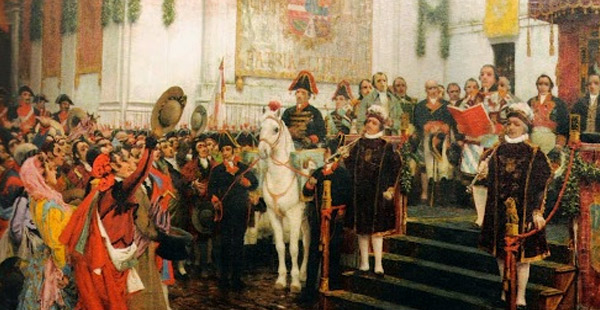
THE CONSTITUTION OF CADIZ
Approved on 19th March 1812. Known as “La Pepa”, this legal document was the first Constitution in Spain. The liberal deputies Agustín Argüelles, Diego Muñoz Torrero and Pérez de Castro are the most outstanding people in its preparation. The main legal reforms contained in the Cadiz
- National sovereignty. The power is in the nation, not in the king.
- Division of Powers:
- Legislative power: Unicameral Cortes.
- Judicial power: Tribunals
- Executive power: the king + Ministers, with limitations:
- He cannot dissolve the Cortes.
- He had a transitive veto during 2 years, after that the decision of the Cortes became law.
- He could name his ministers, but they had to be approved by the Cortes (“doble confianza”).
- Male universal suffrage. All man older than 25 years old could vote, indirectely, they chose some representatives (compromisarios) that could choose their deputies.
- Equality of all citizens.
- Individual rights: education, freedom of press, inviolability of home, freedom, association and property.
- The Catholicism would be the only allowed religion. They had to count with the clergy support to fight against French, this explains that only intolerant feature in such an advance Constitution.
In 1814, after the return of Fernando VII, the Constitution was repealed.

POWERPOINT PRESENTATION ON THE TOPIC:
CORTES DE CADIZ AND CONSTITUTION OF 1812
NOTES READY TO STUDY:
THE CORTES OF CADIZ AND THE FIRST SPANISH CONSTITUTION
VIDEOS TO REVIEW:
 3travellingacrosstime